Oval Segmented Bend flat pattern
What it is
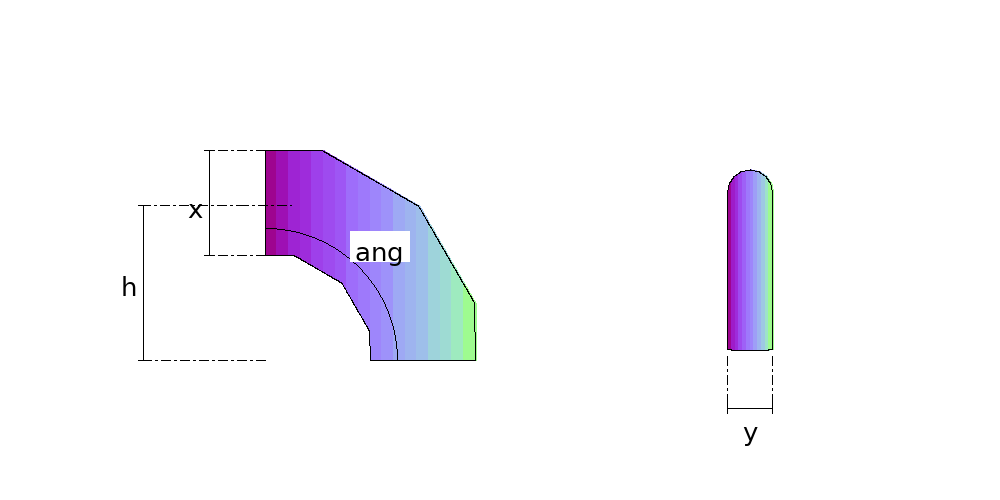
The segmented bend for OVAL duct -- the obround, two half-rounds joined by two straight runs. The catalogue already had the round segmented bend and the rectangular duct bend; this is the third sister, and it is the section of flat-oval duct, used where the headroom will not take the equivalent round.
Where it is used
Flat-oval extraction and air-conditioning duct, runs between beam and ceiling, industrial hoods, pneumatic conveying in tight spaces.
Measurements the calculation needs
- H Height
- X Measurement X
- Y Measurement Y
- ANG Angle
- S Sections
- DV Divisions
- THK Thickness
Worked example
The values the form comes pre-filled with, run through the tool itself:
| Height | 900 mm |
|---|---|
| Measurement X | 600 mm |
| Measurement Y | 300 mm |
| Angle | 90° |
| Sections | 3 |
| Divisions | 16 |
| Thickness | 3 mm |
| The flat pattern fits a plate of | 1533 × 642 mm |
| Flat patterns produced | 2 |
Frequently asked questions
- Does it cover the oval both ways round?
- It does, on the same page. Measurement X is the one in the plane the bend turns in and Measurement Y is across it, with no requirement about which is larger -- make X larger for one orientation, Y larger for the other. It is not the same drawing rotated, which is why the shops that sell single templates charge for the two separately.
- Why is the cut not the sine curve of the round bend?
- Because the height of the cut depends on how far the point stands from the axis of the bend, and on an oval that distance follows two different paths in one lap. Round the half-rounds it varies as a cosine, as on the round bend; along the straight runs it varies linearly or stays put, as on the rectangular one. The oval cut is neither known curve -- it is the two spliced together, and that is why nobody gets this one right from memory.
- How many plates come out?
- Two different ones. The half end gore is cut twice, once at each end of the bend, and the full middle gore is cut the number of gores minus one. With a single gore the part is just the two half ends and there is no middle gore.
- Does the throat come out square?
- It depends on the orientation, and it is worth checking before marking out. With Measurement Y larger, the throat and the heel are the STRAIGHT runs, all at the same distance from the axis, so the cut does not vary along them -- it comes out square, however tight the bend. With Measurement X larger the throat is the half-round, and there the cut varies point by point.
- How many gores should it have?
- By the same rule as the round bend. Each gore turns the total angle divided by their number, and none may turn more than 90 degrees -- that is the 45-degree mitre, the steepest cut still workable. More gores make a smoother bend and less pressure drop, at the cost of more welding.
Calculate a Oval Segmented Bend
An account is required. The free tier covers 20 calculations a month.