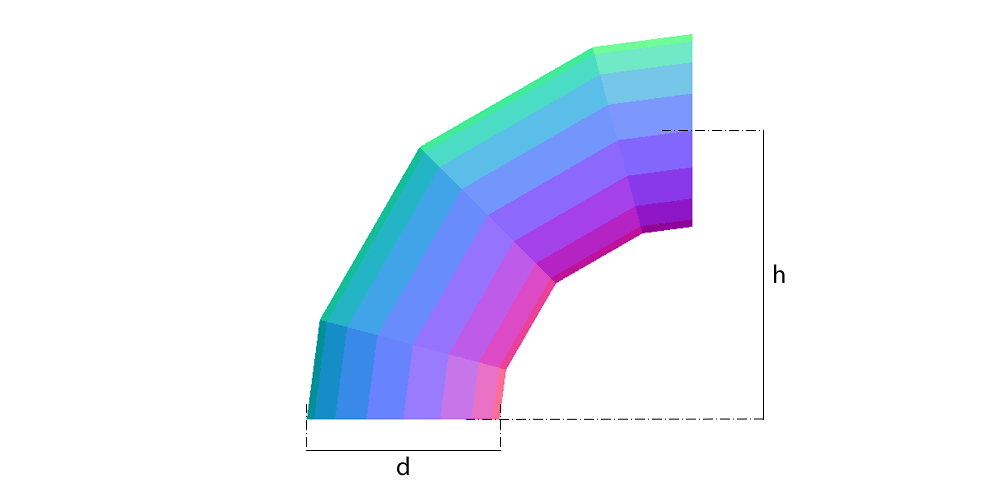
90° Bend flat pattern
What it is
The segmented bend with its angle fixed at 90 degrees — the most common case in practice, with the angle field locked so it cannot be mistyped. Everything else works as the free segmented bend: you choose diameter, radius and gore count.
Where it is used
Direction changes in exhaust and ventilation ducting, large-diameter elbows fabricated from plate.
Measurements the calculation needs
- H Height
- D Diameter
- ANG Angle
- S Sections
- DV Divisions
- THK Thickness
Worked example
The values the form comes pre-filled with, run through the tool itself:
| Height | 1200 mm |
|---|---|
| Diameter | 800 mm |
| Angle | 90° |
| Sections | 3 |
| Divisions | 16 |
| Thickness | 10 mm |
| The flat pattern fits a plate of | 2482 × 855 mm |
| Flat patterns produced | 2 |
Frequently asked questions
- How does this differ from the general segmented bend?
- Not at all in the calculation: it is the same part with the angle pinned to 90 degrees. It exists separately to avoid mistyping the angle, which is the field that causes the most rework.
- Can I use only two gores?
- You can, and the result is the simple two-piece elbow. Above that the bend gets smoother and pressure loss drops.