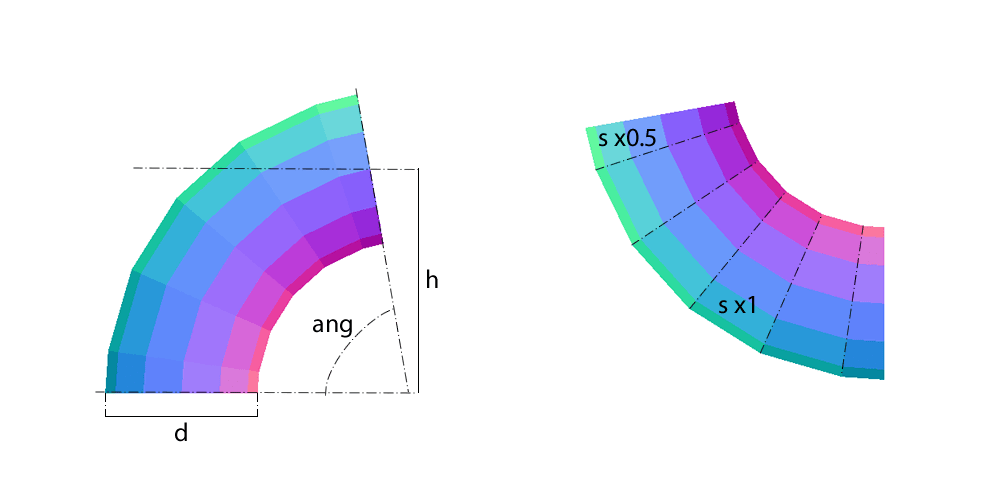
Bend flat pattern
What it is
A segmented bend is built from lengths of tube cut at an angle and welded together, approximating a radius with straight pieces. Each intermediate gore is a cylinder cut at both ends; the two end gores take a single cut. The more gores, the smoother the bend.
Where it is used
Large-diameter bends in exhaust and ventilation, boiler ducting, process pipework where no forged elbow exists in the required size.
Measurements the calculation needs
- H Height
- D Diameter
- ANG Angle
- S Sections
- DV Divisions
- THK Thickness
Worked example
The values the form comes pre-filled with, run through the tool itself:
| Height | 1200 mm |
|---|---|
| Diameter | 800 mm |
| Angle | 80° |
| Sections | 5 |
| Divisions | 16 |
| Thickness | 10 mm |
| The flat pattern fits a plate of | 2482 × 448 mm |
| Flat patterns produced | 2 |
Frequently asked questions
- How many gores should I use?
- It is the trade between finish and work: more gores follow the radius better and reduce pressure loss, but mean more cuts and more welding. For a 90 degree exhaust bend, three to five usually does it.
- What is measurement H?
- The bend radius measured at the tube axis. The calculation requires it to be at least half the diameter, or the gores would intersect.