Cylinder with Branch Hole flat pattern
What it is
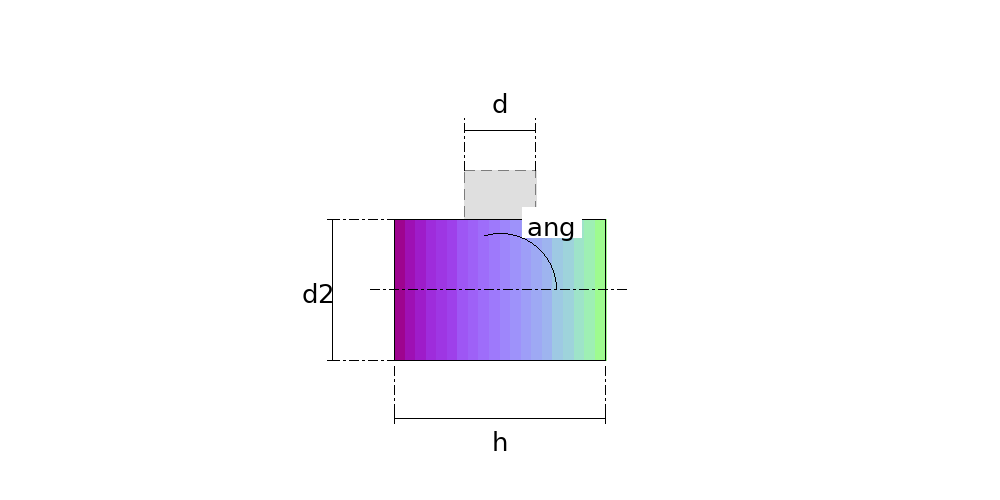
The shell course with the branch hole already in it. It is the missing half of every branch job: the branch part gives the pattern for the branch, this one gives the pattern for the pipe it enters. It is also the only sheet in this catalogue with an internal cut-out — the outline comes out with two loops, the rectangle of the course and the hole.
Where it is used
Headers and manifolds with take-offs, vessel shells with nozzles, piping with welded branches, any shell that is going to receive a branch.
Measurements the calculation needs
- D2 Diameter 2
- H Height
- D Diameter
- ANG Angle
- DV Divisions
- THK Thickness
Worked example
The values the form comes pre-filled with, run through the tool itself:
| Diameter 2 | 400 mm |
|---|---|
| Height | 600 mm |
| Diameter | 200 mm |
| Angle | 90° |
| Divisions | 32 |
| Thickness | 6 mm |
| The flat pattern fits a plate of | 1238 × 600 mm |
Frequently asked questions
- Which diameter do I enter, the branch or the hole?
- The HOLE, and the difference matters: for a branch set on top of the shell the hole goes at the branch's bore, so the branch wall has a seat; for a branch set into the hole, at its outside diameter. The welder decides, and the number entered is the decision — that way the calculation need not assume the branch's wall thickness, which may not match the shell's.
- Why does the hole come out wider than the diameter I entered?
- Because the sheet is flat and the pipe is round. Unrolling the shell stretches everything off the mid-line. A 200 hole in a 400 shell in 6 mm plate comes out 206.3 wide on the sheet — a little over 3% more.
- And the hole's length along the pipe?
- It is the diameter divided by the sine of the angle, exactly. At 90 degrees that is the diameter itself; at 45, forty-one percent more. Not a guess: the algebra closes in two lines.
- Where does the shell seam go?
- Diametrically opposite the hole, which is where it goes on the part — a longitudinal weld does not run through a cut-out.
Calculate a Cylinder with Branch Hole
An account is required. The free tier covers 20 calculations a month.