Obround to Rectangle flat pattern
What it is
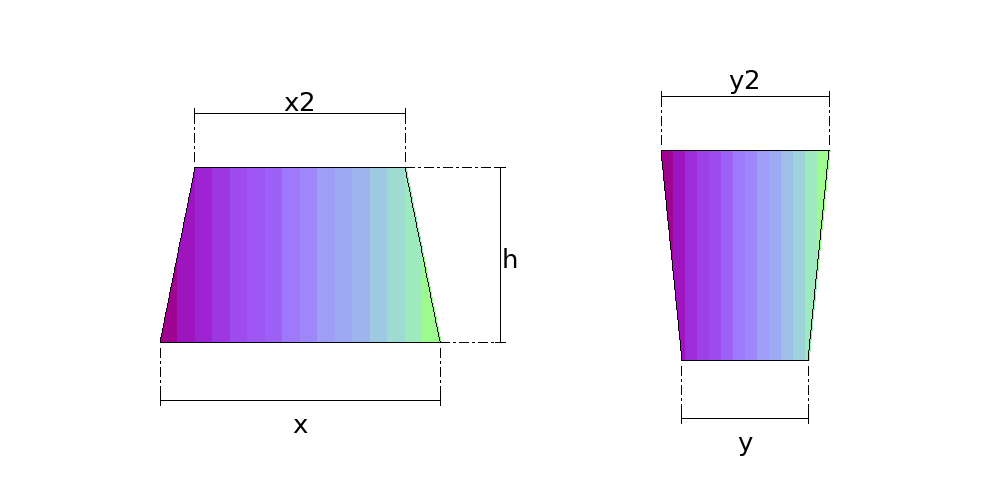
The transition between a flattened obround mouth and a rectangular one, in parallel planes on the same axis. It is the other end of the round-to-oval job — the flattened duct gets through the low gap and then has to meet the rectangular frame of a filter, a fan or a hood.
Where it is used
Industrial exhaust, connecting flat oval duct to a filter frame, fan mouths, commercial kitchen hoods, anywhere obround meets rectangular.
Measurements the calculation needs
- X Measurement X
- Y Measurement Y
- X2 Top X
- Y2 Top Y
- H Height
- DV Divisions
- THK Thickness
Worked example
The values the form comes pre-filled with, run through the tool itself:
| Measurement X | 800 mm |
|---|---|
| Measurement Y | 300 mm |
| Top X | 600 mm |
| Top Y | 400 mm |
| Height | 500 mm |
| Divisions | 16 |
| Thickness | 3 mm |
| The flat pattern fits a plate of | 1984 × 609 mm |
Frequently asked questions
- Does the pattern have creases?
- None at all. At both meetings the obround's tangent is parallel to the rectangle side it meets — at the end of the straight run it lies along x, at the tip of the obround along y — and all four flat faces touch the mouth without cutting through it. That is what separates this part from the angular boot, which has two creases and cannot avoid them.
- Can the rectangle be larger than the obround?
- It can, in both directions at once. There is no guard tying one to the other, and there should not be — with both mouths in parallel planes the tangency points do not move with the rectangle's size, and the part simply flares outward.
- Why can't the obround be a circle?
- Because then the two flat trapezoids degenerate and the part becomes a different one — the rectangle-to-round, which is already in this catalogue. The guard asks for half a millimetre of straight run per side.
- Where does the seam go?
- In the middle of one of the straight runs, rising to the middle of the rectangle's long side. That is one whole flat face, so the weld falls on a straight line.
Calculate a Obround to Rectangle
An account is required. The free tier covers 20 calculations a month.