Offset Pipe Branch (Tangential Inlet) flat pattern
What it is
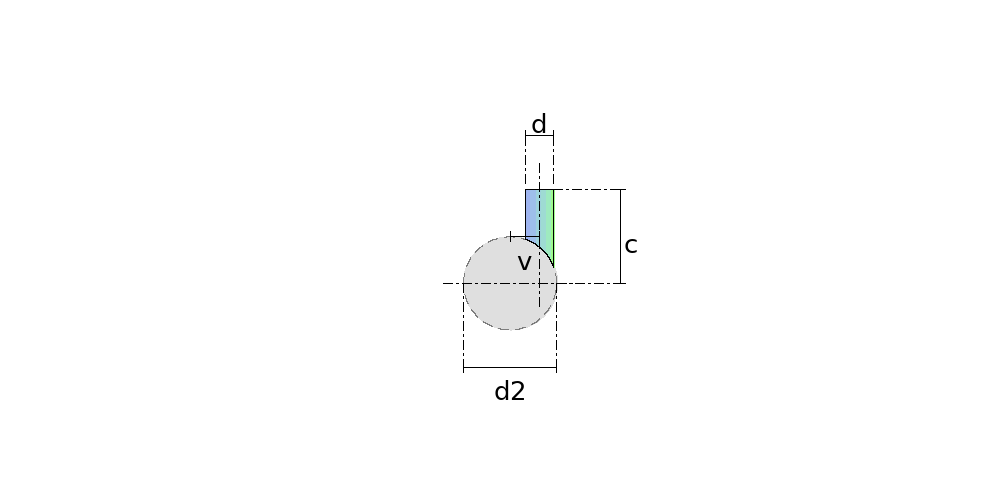
The branch whose axis does NOT cross the main pipe's — the tangential inlet. The ordinary branch requires the two axes to intersect, and so cannot do this one: cyclone inlets, tank feeds, any branch set to one side so the flow enters spinning instead of head-on.
Where it is used
Tangential cyclone and hydrocyclone inlets, swirl tank feeds, side take-offs on headers, runouts offset for want of room.
Measurements the calculation needs
- D Diameter
- D2 Diameter 2
- C Branch length
- V Outlet offset
- DV Divisions
- THK Thickness
Worked example
The values the form comes pre-filled with, run through the tool itself:
| Diameter | 150 mm |
|---|---|
| Diameter 2 | 500 mm |
| Branch length | 500 mm |
| Outlet offset | 160 mm |
| Divisions | 32 |
| Thickness | 5 mm |
| The flat pattern fits a plate of | 456 × 408 mm |
Frequently asked questions
- What changes in the pattern compared with the ordinary branch?
- The symmetry. On a centred branch the mouth has two equal troughs; here it has one deep and one shallow. At the tangential limit the shallow one disappears altogether and the mouth touches the pipe's side line.
- Can the offset reach the side of the pipe?
- It can, and that is exactly the case the part is named for: with the offset plus the branch's radius equal to the pipe's radius, the branch is tangent. The calculation accepts equality. Past it the branch would run off the side and there would be no closed mouth to cut.
- Where do I measure the length from?
- From the AXIS of the main pipe to the end of the branch, as on the ordinary branch — the centre-to-face dimension.
- And at zero offset?
- The part is exactly the ordinary branch at 90 degrees, and both are in this catalogue. I checked station by station: they give the same heights, with no difference at all.
Calculate a Offset Pipe Branch (Tangential Inlet)
An account is required. The free tier covers 20 calculations a month.