Rectangular Duct Bend flat pattern
What it is
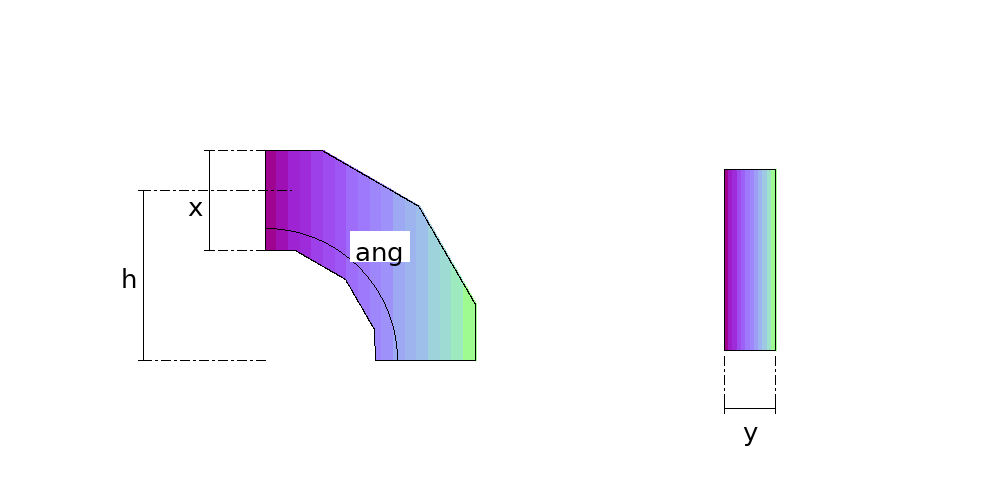
The mitred bend with its section changed: a rectangular duct instead of a round shell. The cut is the same calculation as the round bend — the mitre height at a point is its distance from the bend axis times the tangent of half the angle per gore. What changes is the path: on the round one that distance varies as a cosine and the cut comes out a sine wave; here it is constant on two faces and varies linearly on the other two.
Where it is used
Extraction and air-conditioning ductwork, dust collection runs, ventilation trunking, any change of direction in rectangular section.
Measurements the calculation needs
- H Height
- X Measurement X
- Y Measurement Y
- ANG Angle
- S Sections
- THK Thickness
Worked example
The values the form comes pre-filled with, run through the tool itself:
| Height | 800 mm |
|---|---|
| Measurement X | 500 mm |
| Measurement Y | 300 mm |
| Angle | 90° |
| Sections | 3 |
| Thickness | 1.5 mm |
| The flat pattern fits a plate of | 1594 × 281 mm |
| Flat patterns produced | 2 |
Frequently asked questions
- Are all four faces of a gore cut the same?
- No, and that is the classic mistake on this part. The throat and heel faces come out RECTANGULAR, cut square, however tight the bend — each of them lies wholly at one distance from the axis, so the cut does not vary along it. Only the two side faces come out trapezoidal.
- Where is the radius measured to?
- To the bend axis, at the centre of the section. The throat is half of X inside it and the heel half of X outside, and that difference is what makes the heel come out longer than the throat.
- Why are there two sheets?
- Because the end gores are cut once and the middle ones twice. The first sheet comes in two copies — the two half-ends — and the second in one fewer than the number of gores. With a single gore the part is just the two half-ends, and the second sheet does not exist.
- Is there a limit to the angle per gore?
- Ninety degrees, the same as the round bend. At that point the half-mitre reaches 45 degrees, which is the single-cut mitred elbow. Past it the cut is steeper than 45 degrees and the part stops being makeable — anyone needing more turn adds gores.
Calculate a Rectangular Duct Bend
An account is required. The free tier covers 20 calculations a month.