Truncated Rectangular Tube flat pattern
What it is
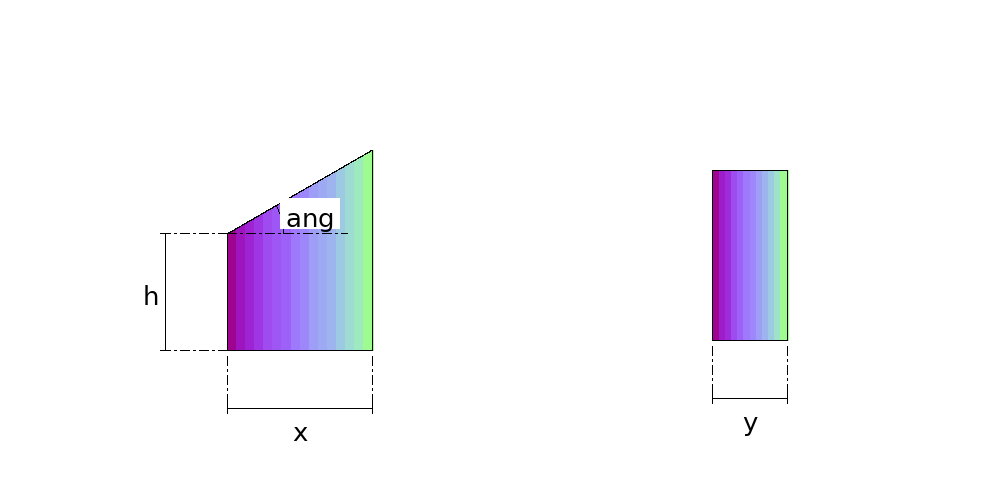
The rectangular-section duct that ends on a tilted plane — a roof, a sloping wall, the bottom of a funnel. It is to the rectangular section what the truncated cylinder is to the round shell, and the catalogue had one without the other. Rolled flat, the mouth becomes a line of four runs: straight on the low and high faces, sloping on the two sides.
Where it is used
Ducts dying into a roof or a sloping wall, intakes beside a graded floor, duct connections to equipment with a tilted face.
Measurements the calculation needs
- X Measurement X
- Y Measurement Y
- H Height
- ANG Angle
- THK Thickness
Worked example
The values the form comes pre-filled with, run through the tool itself:
| Measurement X | 500 mm |
|---|---|
| Measurement Y | 300 mm |
| Height | 400 mm |
| Angle | 30° |
| Thickness | 1.5 mm |
| The flat pattern fits a plate of | 1594 × 688 mm |
Frequently asked questions
- Are all four faces cut the same?
- No, and it is the same trap as the rectangular bend. The low and high faces come out RECTANGULAR, cut square: each lies wholly at one distance from the axis, so the cut does not vary along it. Only the two side faces come out trapezoidal.
- Which side is the height given for?
- The LOW side. The high side follows from the arithmetic — it is the given height plus the width times the tangent of the angle. Same convention as the truncated cylinder.
- Why can't the angle reach 90 degrees?
- Because at 90 the plane runs parallel to the tube's axis and cuts no mouth at all — it slides down the side instead of crossing. And at zero the part is a straight tube, with no cut.
- Where does the seam go?
- In the middle of the low face, which is the shortest generator and so the shortest weld. And on a straight line, which closes better than a corner.
Calculate a Truncated Rectangular Tube
An account is required. The free tier covers 20 calculations a month.