Rectangular Tap on a Cone flat pattern
What it is
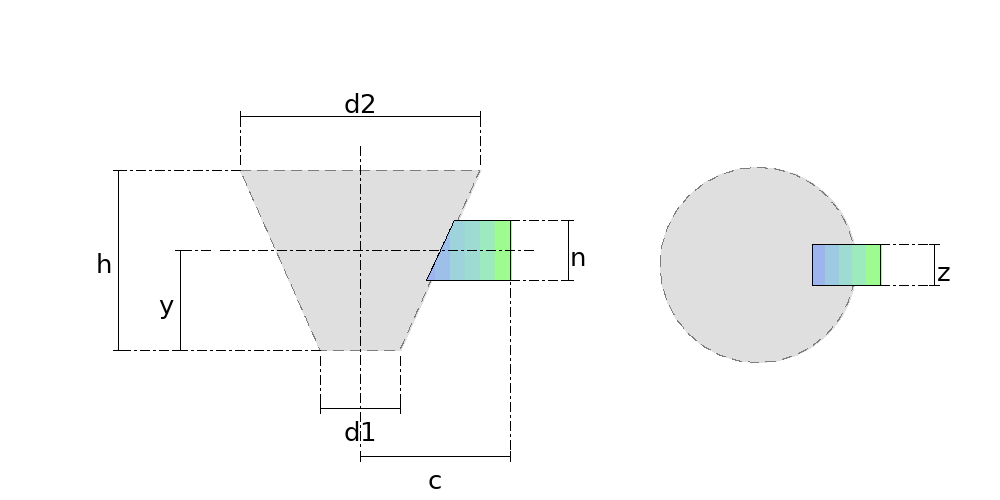
The rectangular collar seated on the wall of a truncated cone, its axis horizontal and crossing the cone's axis. It is the grille mouth and the chute on a conical hopper — the same part as the rectangular tap on pipe, but on a host whose radius changes with height.
Where it is used
Conical hoppers, silos, cyclone bodies, conical hoods, grille and chute mouths on any conical wall.
Measurements the calculation needs
- D1 Diameter 1
- D2 Diameter 2
- H Height
- N Outlet length
- Z Outlet width
- Y Measurement Y
- C Branch length
- DV Divisions
- THK Thickness
Worked example
The values the form comes pre-filled with, run through the tool itself:
| Diameter 1 | 400 mm |
|---|---|
| Diameter 2 | 1200 mm |
| Height | 900 mm |
| Outlet length | 300 mm |
| Outlet width | 250 mm |
| Measurement Y | 500 mm |
| Branch length | 750 mm |
| Divisions | 16 |
| Thickness | 4 mm |
| The flat pattern fits a plate of | 1084 × 415 mm |
Frequently asked questions
- Which figure runs along the cone's axis?
- `n`, the mouth length. `z` runs across. It is the same rule as the rectangular tap on pipe, where the length follows the pipe's length — and it matters more here, because the two bites belong to different families: swapping the two figures does not give the same part rotated, it gives a different part.
- Why are the four bites all different?
- Because the cone changes radius with height. The two walls perpendicular to the cone's axis lie in planes of constant height, and such a plane cuts the cone in the very circle of that height: the bite is an exact arc, and the two arcs have different radii. The two parallel walls lie in planes of constant offset, and there the bite is a hyperbola. The part comes out deeper at the top than at the bottom.
- Where do I measure c from?
- From the cone's AXIS to the tip of the collar, the same datum as the cone branch. The guard asks it to clear the deepest bite, which is at the middle of the upper wall.
- What about the hole in the cone?
- That is the companion part, "Cone with Rectangular Hole" — and it is worth far more than the name suggests, because the hole is NOT a rectangle. Enter the same figures in both and the two patterns match.
Calculate a Rectangular Tap on a Cone
An account is required. The free tier covers 20 calculations a month.