Rectangular Transition flat pattern
What it is
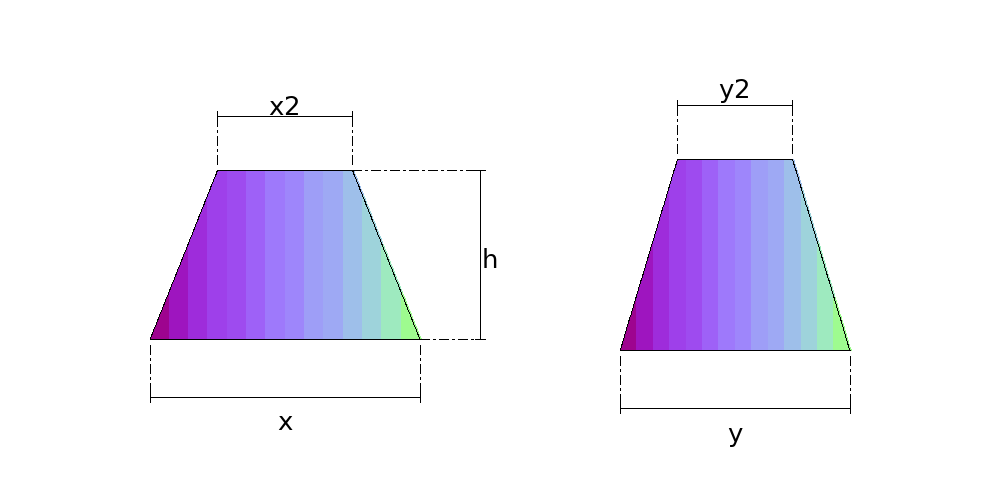
The pyramid frustum: the reducer between two rectangular openings, on the same axis. It is the only transition in this catalogue that is not triangulated, and does not need to be — each of the four faces has its bottom edge parallel to its top one, so the face is a flat trapezoid and its pattern is the face itself, with no approximation.
Where it is used
Reducers in exhaust and air-conditioning ductwork, hoppers and silo outlets, feed chutes, transitions between rectangular-section equipment.
Measurements the calculation needs
- X Measurement X
- Y Measurement Y
- X2 Top X
- Y2 Top Y
- H Height
- THK Thickness
Worked example
The values the form comes pre-filled with, run through the tool itself:
| Measurement X | 800 mm |
|---|---|
| Measurement Y | 600 mm |
| Top X | 400 mm |
| Top Y | 300 mm |
| Height | 500 mm |
| Thickness | 3 mm |
| The flat pattern fits a plate of | 1680 × 1509 mm |
Frequently asked questions
- Why is this part not triangulated like the rectangle-to-round?
- Because all four faces are flat. Two parallel lines always lie in one plane, and here the bottom edge of each face is parallel to its top edge — so there is no curved surface to approximate with triangles. On the rectangle-to-round one opening is a circle, and then no face is flat at all.
- Is the slant height the same on all four faces?
- No, and that is exactly where marking out from memory goes wrong. The face with X at the bottom steps back (Y − Y2)/2 and the face with Y steps back (X − X2)/2, so each pair has its own slant height. They only coincide when the reduction is equal in both directions.
- Can the top opening be larger than the bottom one?
- Yes, and in one direction only if you like — widening in X while narrowing in Y is routine in ductwork. The calculation does not distinguish a reducer from an expander.
- What if both openings are the same?
- You get a straight rectangular tube, and the pattern is a plain rectangle of perimeter by height. That is a real part, not a degenerate case, and the calculation accepts it.
Calculate a Rectangular Transition
An account is required. The free tier covers 20 calculations a month.