Conical Tap (Conical Tee) flat pattern
What it is
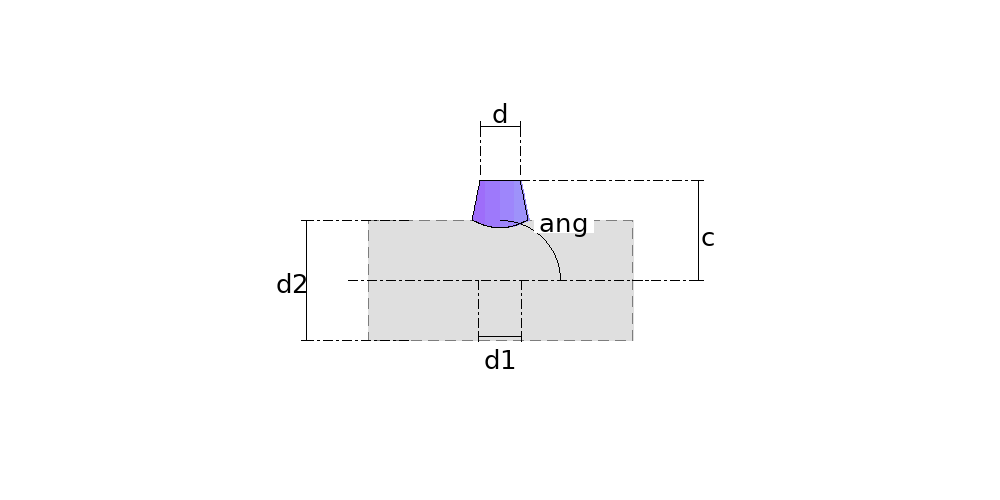
The nozzle that leaves the pipe flared at the base and tapers to the collar. The ordinary branch handles a cylindrical branch on a pipe and the cone branch handles a cylindrical branch on a cone; what was missing is the CONICAL branch on a pipe — the real nozzle on most vessels, because flaring the base spreads the weld's stress instead of concentrating it in a narrow mouth.
Where it is used
Pressure vessel and tank nozzles, reinforced take-offs on headers, cyclone inlets with a flared base, conical manway necks.
Measurements the calculation needs
- D Diameter
- D1 Diameter 1
- D2 Diameter 2
- C Branch length
- ANG Angle
- DV Divisions
- THK Thickness
Worked example
The values the form comes pre-filled with, run through the tool itself:
| Diameter | 200 mm |
|---|---|
| Diameter 1 | 400 mm |
| Diameter 2 | 600 mm |
| Branch length | 500 mm |
| Angle | 90° |
| Divisions | 32 |
| Thickness | 6 mm |
| The flat pattern fits a plate of | 807 × 307 mm |
Frequently asked questions
- What does the larger diameter measure, if the big mouth is a saddle?
- It measures the cone's FICTITIOUS base at the pipe's axis — the diameter it would have if it ran down that far. The big mouth is a saddle and has no circle in any plane, so there is nothing to measure on it; the fictitious base is the catalogue convention, and it is the only measurement that closes the part alongside the collar and the length.
- Is the mouth an arc struck with a compass?
- No. The collar is, and it is the sector's constant-radius arc — struck with the compass at the apex. The mouth has a different radius at every station and is marked point by point, like the angle-cut cone's. The difference is that there the polyline was on the inside and here it is on the outside.
- Why does the length have a minimum that depends on the angle?
- Because on a tilted nozzle the mouth is shallower on one side, and if the collar falls short of it the part would have negative length there. The condition falls out of the arithmetic: 2·c·sin(ang) has to exceed d2 + d·cos(ang). At 90 degrees that becomes c greater than half of d2, which is the ordinary branch's guard.
- And if the taper is very small?
- The part is a cylindrical branch, and there is a part for that. Below a millimetre of difference between the two diameters the cone's apex runs too far away and the sector degenerates — the calculation refuses, for the same reason and with the same guard the cone has.
Calculate a Conical Tap (Conical Tee)
An account is required. The free tier covers 20 calculations a month.