Eccentric Rectangle to Round flat pattern
What it is
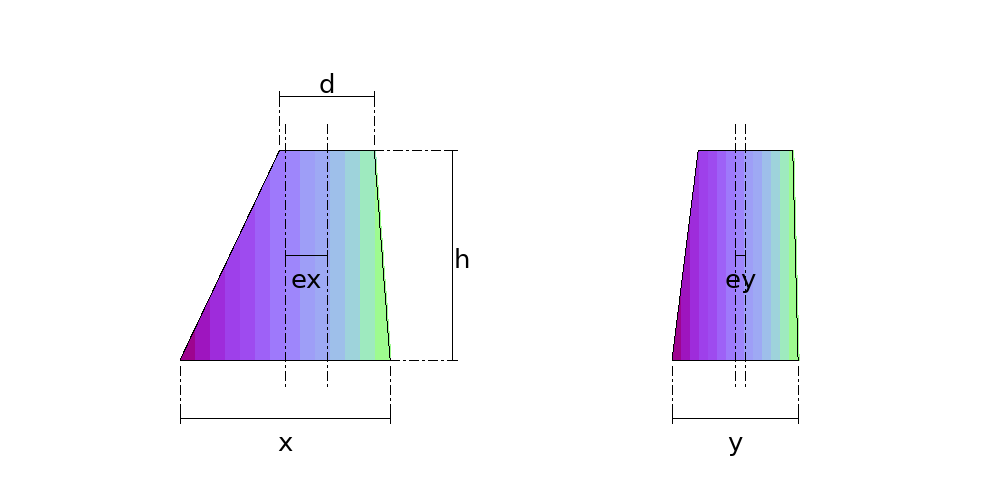
The rectangle-to-round transition with the round opening off centre. It is a different part from the concentric one, not a case of it: there all four corners are alike and half a pattern mirrored will do; here every corner has its own true lengths and the pattern has to be walked right around, once.
Where it is used
Connecting misaligned equipment to ductwork, chute and trough outlets, extraction hoods over a bench against a wall, off-axis fan take-offs.
Measurements the calculation needs
- X Measurement X
- Y Measurement Y
- D Diameter
- H Height
- EX Offset in X
- EY Offset in Y
- DV Divisions
- THK Thickness
Worked example
The values the form comes pre-filled with, run through the tool itself:
| Measurement X | 1000 mm |
|---|---|
| Measurement Y | 600 mm |
| Diameter | 450 mm |
| Height | 1000 mm |
| Offset in X | 200 mm |
| Offset in Y | 50 mm |
| Divisions | 16 |
| Thickness | 3 mm |
| The flat pattern fits a plate of | 2317 × 1664 mm |
Frequently asked questions
- Where is the offset measured from?
- From the centre of the rectangular opening to the centre of the round one, split into the two directions. Zero offset in both gives exactly the concentric transition — I checked, and the pattern area matches the concentric part in this same catalogue to four decimal places.
- Why can't the pattern be mirrored like the concentric one?
- Because the symmetry is gone. On the concentric part the four corner fans are the same cone repeated, so half the pattern mirrored gives the other half. Move the circle and they become four different oblique cones: every corner edge has its own true length, and no half serves as the mirror of the other.
- Can the round opening cross the edge of the rectangle?
- No, and the calculation refuses it. Outside the rectangle's footprint the surface would fold into itself — there would be no part left, and the triangles would come out with their apex on the wrong side of the base.
- Do the divisions of the round opening change the pattern?
- They do, and for the better the more there are. The round edge is approximated by segments, and each extra division approximates it more closely. The divisions are taken along the arc and not along the chord, precisely so the opening does not come out short.
Calculate a Eccentric Rectangle to Round
An account is required. The free tier covers 20 calculations a month.