Cylinder with Rectangular Hole flat pattern
What it is
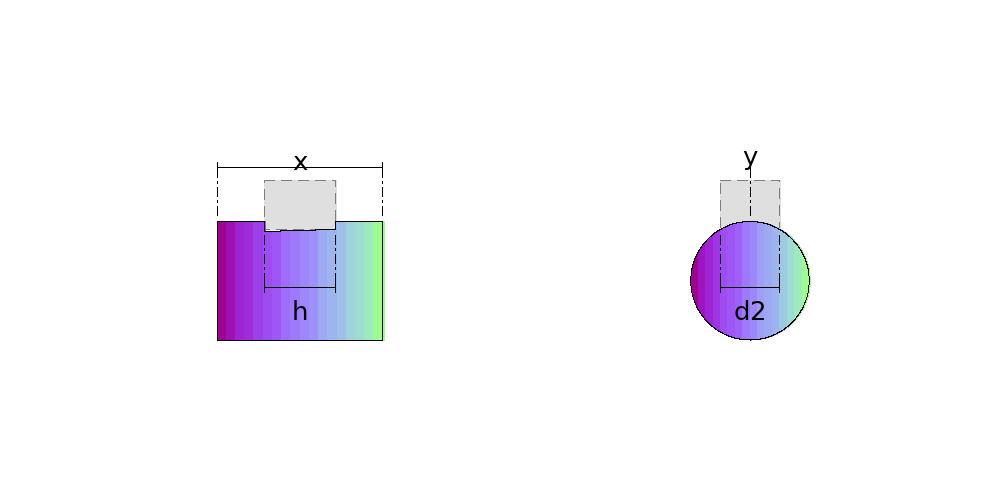
The shell with the rectangular tap's hole already marked — the mate of the rectangular tap, and the half that carries the number people get wrong. The hole IS a rectangle, which is what fools everyone; but the side that runs across the shell does not measure y.
Where it is used
Headers receiving rectangular ducts, shells for intake mouths, cyclone bodies with a rectangular inlet, any pipe that has to take a rectangular collar.
Measurements the calculation needs
- D2 Diameter 2
- H Height
- X Measurement X
- Y Measurement Y
- THK Thickness
Worked example
The values the form comes pre-filled with, run through the tool itself:
| Diameter 2 | 500 mm |
|---|---|
| Height | 700 mm |
| Measurement X | 300 mm |
| Measurement Y | 250 mm |
| Thickness | 3 mm |
| The flat pattern fits a plate of | 1561 × 700 mm |
Frequently asked questions
- Why is the hole a rectangle at all?
- Because the collar's walls meet the cylinder along curves that unroll straight. The two perpendicular to the axis meet it along circles, which become lines of constant position along the pipe; the two parallel to the axis meet it along straight lines, which become lines of constant position around it. Straight on all four sides.
- Then why isn't it x by y?
- Because the sheet stretches when it unrolls. The side across measures the arc that y occupies: 2·Rn·asin(y/d2). On a 500 shell with a 250 tap it comes out 260.2. The wider the tap relative to the pipe, the worse — at a tap half the pipe's diameter the stretch passes 5%, and near the limit it passes 50%.
- What is the limit on the width?
- Half a turn. At y equal to the shell's mid-line diameter the hole opens exactly half the circumference and there is no shell left either side of it. The calculation refuses past that.
- Does it match the rectangular tap?
- It does, and it is its mate. Enter the same pipe and the same collar section in both parts and you have both patterns for the job.
Calculate a Cylinder with Rectangular Hole
An account is required. The free tier covers 20 calculations a month.