Cylinder with Conical Branch Hole flat pattern
What it is
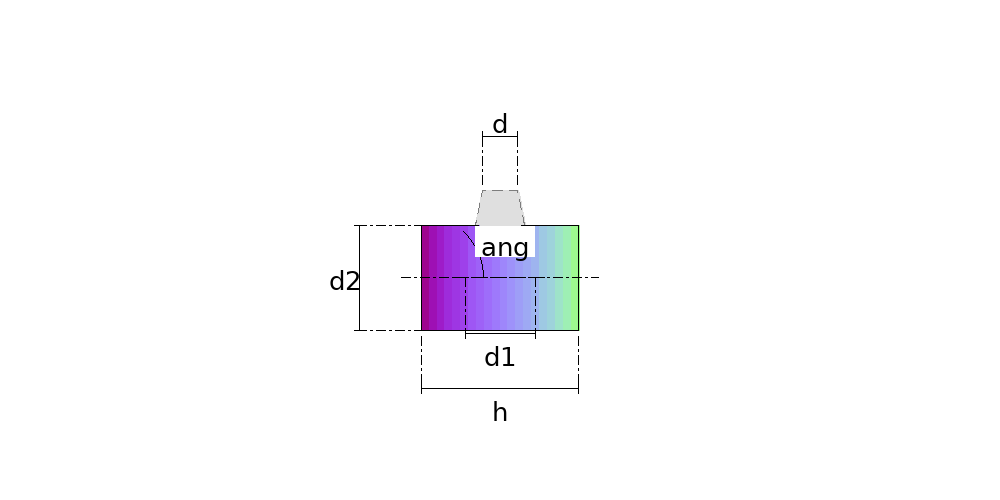
The shell with the CONICAL nozzle's hole already marked — the mate of the conical tap, and the part that closes the job. The round-hole shell will not do: a conical nozzle reaches the shell already flared, which is the whole point of it, and opens a larger hole of a different shape.
Where it is used
Vessel shells with reinforced nozzles, headers with flared take-offs, cyclone bodies, any shell that is going to receive a flared-base nozzle.
Measurements the calculation needs
- D2 Diameter 2
- H Height
- D Diameter
- D1 Diameter 1
- C Branch length
- ANG Angle
- DV Divisions
- THK Thickness
Worked example
The values the form comes pre-filled with, run through the tool itself:
| Diameter 2 | 600 mm |
|---|---|
| Height | 900 mm |
| Diameter | 200 mm |
| Diameter 1 | 400 mm |
| Branch length | 500 mm |
| Angle | 90° |
| Divisions | 32 |
| Thickness | 6 mm |
| The flat pattern fits a plate of | 1866 × 900 mm |
Frequently asked questions
- Why can't I use the round-hole shell with the collar diameter?
- Because the cone does not reach the shell at the collar diameter — it reaches it flared. On a nozzle with a 200 collar and a 400 fictitious base in a 600 shell, the hole comes out 298 by 274, against the 206 of a 200 cylindrical branch. Marking it by the collar makes a hole too small for the cone to pass.
- What do I enter?
- The same four figures as the conical tap — collar, fictitious base, length and angle — plus the pipe and the shell length. Enter the same in both parts and you have both patterns for the job, and they match because the intersection is worked out once, in one place in the code.
- Where does the shell seam go?
- Diametrically opposite the hole. A longitudinal weld does not run through a cut-out.
- Why must the shell be much longer than the hole?
- Because the hole measures the cone's diameter AT THE SHELL'S SURFACE divided by the sine of the angle, and on a tilted nozzle that grows quickly. The guard uses the fictitious base, which is deliberately generous — the cone is narrower where it meets the pipe.
Calculate a Cylinder with Conical Branch Hole
An account is required. The free tier covers 20 calculations a month.