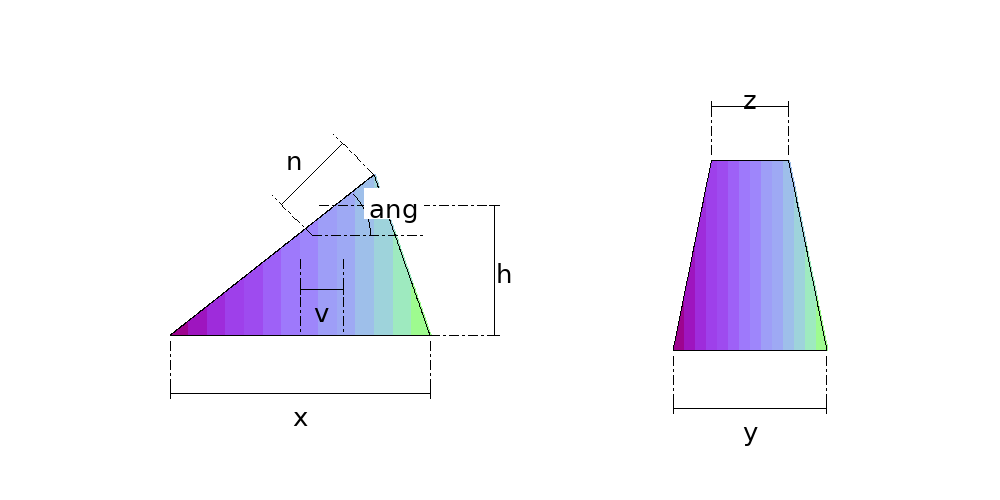
Discharge Chute flat pattern
What it is
A rectangular hopper with its outlet tilted and off centre — the spout the material drops through onto whatever carries it next. Because the outlet is tilted, the four faces are no longer flat: the bottom edge of each is not parallel to its top edge, the quadrilateral is skew, and the pattern comes out by triangulation.
Where it is used
Silo and bin discharge, transfer between conveyors, crusher and screen spouts, mixer feed.
Measurements the calculation needs
- X Measurement X
- Y Measurement Y
- N Outlet length
- Z Outlet width
- V Outlet offset
- ANG Angle
- H Height
- THK Thickness
Worked example
The values the form comes pre-filled with, run through the tool itself:
| Measurement X | 600 mm |
|---|---|
| Measurement Y | 300 mm |
| Outlet length | 200 mm |
| Outlet width | 150 mm |
| Outlet offset | 100 mm |
| Angle | 45° |
| Height | 300 mm |
| Thickness | 3 mm |
| The flat pattern fits a plate of | 882 × 833 mm |
Frequently asked questions
- Where is the height measured to?
- To the CENTRE of the outlet, not to its high edge. The outlet tilts about its centre, so it is the centre that sits at the height given and the two edges rise and fall around it — the same convention as the inclined square-to-round.
- Is the outlet length measured horizontally?
- No, it is measured ALONG the tilted outlet, which is where it exists. Horizontally it projects less — the length times the cosine of the angle — and that projection is what the calculation uses to know whether the outlet still fits within the base's footprint.
- Can the outlet cross the edge of the base?
- No. Past it the rear faces would fold into themselves: there would be no part left, and the pattern would measure more material than the part has. The calculation refuses it.
- And with the angle at zero?
- The outlet comes square and the part becomes an offset pyramid frustum, with all four faces flat again. The calculation accepts it, and at zero offset too the pattern matches the rectangular transition in this same catalogue exactly.