Rectangular Tap on Pipe flat pattern
What it is
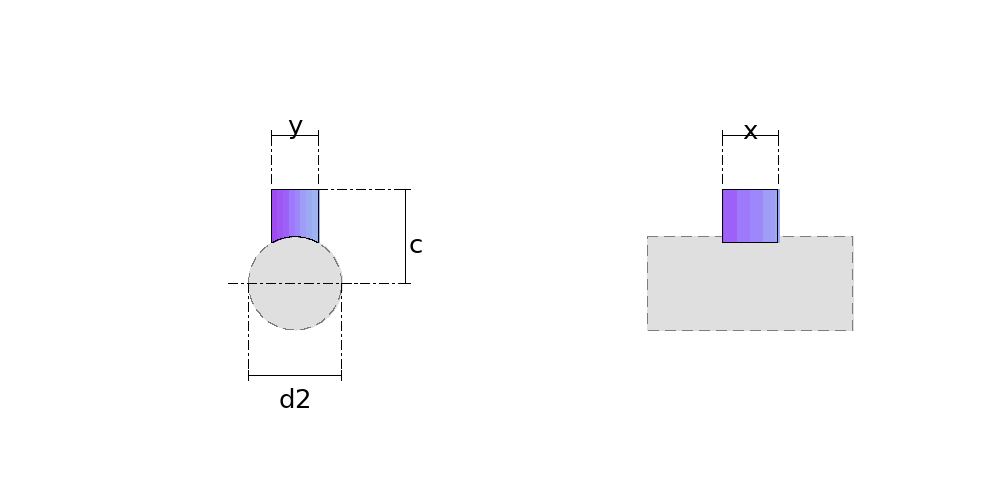
The rectangular-section collar seated on a shell — the mouth where a rectangular duct enters a round pipe. The catalogue had the round branch on a pipe and the rectangular tube cut by a plane, and did not have the rectangular branch cut by the PIPE.
Where it is used
Intake and grille mouths on pipework, rectangular duct entries into a round header, chutes discharging into a pipe, suction take-offs.
Measurements the calculation needs
- D2 Diameter 2
- X Measurement X
- Y Measurement Y
- C Branch length
- DV Divisions
- THK Thickness
Worked example
The values the form comes pre-filled with, run through the tool itself:
| Diameter 2 | 500 mm |
|---|---|
| Measurement X | 300 mm |
| Measurement Y | 250 mm |
| Branch length | 500 mm |
| Divisions | 16 |
| Thickness | 3 mm |
| The flat pattern fits a plate of | 1088 × 283 mm |
Frequently asked questions
- Are all four walls cut the same?
- No, and each pair is cut differently. The two perpendicular to the pipe's axis lie in planes that cut the cylinder in the CIRCLE ITSELF — the bite there is an arc of exact radius. The two parallel to the axis lie in planes that cut the cylinder in STRAIGHT LINES — the bite there is horizontal, the same end to end.
- Why only four fold lines?
- Because all four walls are flat. A station in the middle of an arc is a marking point, not a fold — only the collar's four corners bend. On a rolled part it is the other way round, which is why the round branch has one fold per station.
- And the hole in the shell, is it x by y?
- No, and that is the costliest mistake on this part. The hole is a rectangle, yes, but the side that runs across measures the ARC that y occupies on the shell: 2·Rn·asin(y/d2). On a 500 pipe with a 250-wide tap that is 260.2, not 250. Cut it x by y and the hole is narrow and the collar will not go in. The companion part in this catalogue draws the hole already corrected.
- Where do I measure the collar length from?
- From the AXIS of the pipe to the top face — the centre-to-face dimension, the same convention as the pipe branch. The deepest bite is the radius itself, so the length has to exceed it.
Calculate a Rectangular Tap on Pipe
An account is required. The free tier covers 20 calculations a month.