Cone with Rectangular Hole flat pattern
What it is
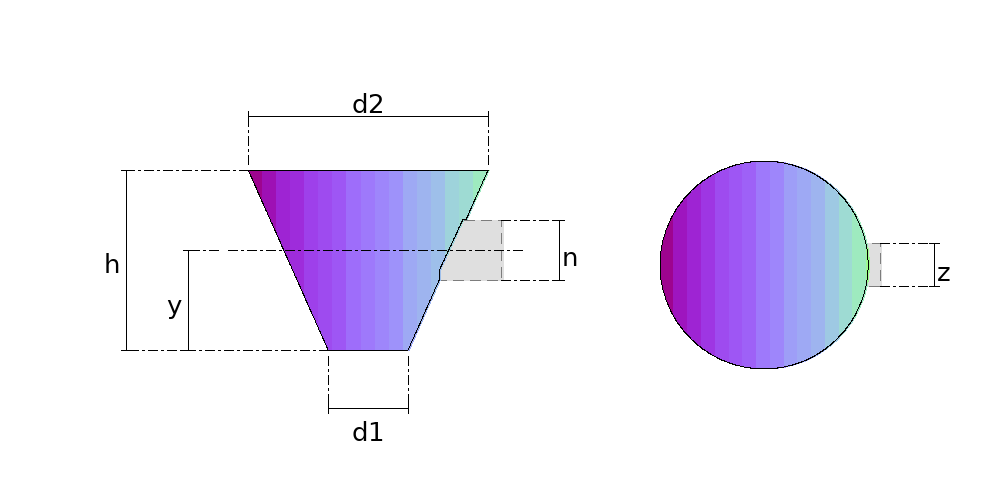
The cone with the rectangular mouth's hole already marked. The name misleads: the hole is not a rectangle, neither on the cone nor on the flat pattern — it is bounded by two circular arcs and two hyperbolas, and on the opened sector it comes out wider at the bottom than at the top.
Where it is used
The other half of the rectangular-tap-on-cone job — hoppers, silos, cyclones, conical hoods.
Measurements the calculation needs
- D1 Diameter 1
- D2 Diameter 2
- H Height
- N Outlet length
- Z Outlet width
- Y Measurement Y
- DV Divisions
- THK Thickness
Worked example
The values the form comes pre-filled with, run through the tool itself:
| Diameter 1 | 400 mm |
|---|---|
| Diameter 2 | 1200 mm |
| Height | 900 mm |
| Outlet length | 300 mm |
| Outlet width | 250 mm |
| Measurement Y | 500 mm |
| Divisions | 16 |
| Thickness | 4 mm |
| The flat pattern fits a plate of | 2818 × 1331 mm |
Frequently asked questions
- Why is the hole not rectangular?
- Because the cone's wall does not open into a rectangle. The two horizontal edges become arcs concentric with the sector's apex, and the two vertical ones become curves that draw together as they rise. The hole is WIDER at the bottom, because the cone is narrower there and the same width subtends more angle.
- How far wrong is marking it by hand as a rectangle?
- Tight at the bottom and loose at the top, and the error grows with the taper and with the height of the mouth. This part's flat pattern is the only way to mark it without trial and error.
- Where does the cone's seam go?
- Diametrically opposite the hole. A longitudinal weld does not run through a cut-out.
- Does the hole match the companion part's mouth?
- It does, and the spec checks it point by point. Both parts walk the same outline, worked out once in one place in the code — if they disagreed, the hole would not take the collar.
Calculate a Cone with Rectangular Hole
An account is required. The free tier covers 20 calculations a month.