Conical Tap on Cone flat pattern
What it is
The cell that was missing. The catalogue already covered a round branch on a pipe, a conical branch on a pipe, a rectangular branch on a pipe, a round branch on a cone and a rectangular branch on a cone — five of the six branch-and-host combinations. This is the sixth: the CONICAL branch that enters a cone. It exists for the same reason as the conical tap on a pipe — flaring the base spreads the weld stress instead of concentrating it in a narrow throat — and on a hopper that matters more, not less: the wall is already sloped and the load slides down against it.
Where it is used
Hopper and conical-silo nozzles, cyclone inlets with a flared base, reinforced take-offs in a conical tank bottom, inspection openings in a tapered stack.
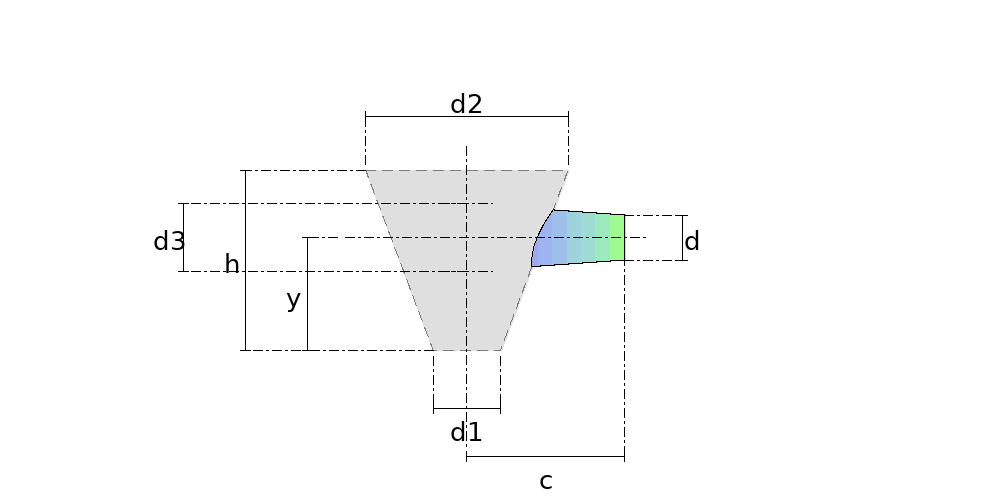
Measurements the calculation needs
- D1 Diameter 1
- D2 Diameter 2
- H Height
- D Diameter
- D3 Diameter 3
- Y Measurement Y
- C Branch length
- DV Divisions
- THK Thickness
Worked example
The values the form comes pre-filled with, run through the tool itself:
| Diameter 1 | 300 mm |
|---|---|
| Diameter 2 | 900 mm |
| Height | 800 mm |
| Diameter | 200 mm |
| Diameter 3 | 300 mm |
| Measurement Y | 500 mm |
| Branch length | 700 mm |
| Divisions | 32 |
| Thickness | 6 mm |
| The flat pattern fits a plate of | 746 × 445 mm |
Frequently asked questions
- What does Diameter 3 measure, if the large end is a saddle?
- It measures the FICTITIOUS base of the tap at the cone axis — the diameter it would have if it reached that far. It is the same convention as the conical tap on a pipe, and for the same reason: the large end seats on a curved surface, so it is not a circle in any plane and there is nothing on it to measure. The dimension diagram shows it as a phantom line, extending the two generators to the axis.
- Why will the existing branch on a cone not do?
- Because there the branch is a pipe of one radius, and here it reaches the wall already flared. The cut curves are different, and marking the hole from the collar is exactly the mistake this part avoids. The two neighbouring parts are not substitutes — they are its LIMITS — with Diameter 3 equal to the collar it becomes the branch on a cone, and with a cylindrical host it becomes the conical tap.
- Is the mouth symmetrical?
- No, and far less so than on a pipe. The host cone is wider at the top, so it pushes the seat further from the axis and the mouth bites deeper on that side. At the default values the seat sits 383 mm from the axis at the top and 289 mm at the bottom — almost ten centimetres of difference on the same part.
- Where does the seam go?
- At the top, and the choice is measured rather than copied: there the sector radius is smaller and the weld comes out at 318 mm, against 415 mm if it went to the bottom — almost a third more weld on the wrong side. It is also the right side for the part: on a hopper the material slides down against the underside of the nozzle, and a seam there is the first place to open.
An account is required. The free tier covers 20 calculations a month.