Oval to Oval Reducer flat pattern
What it is
The reducer for oval duct that stays oval -- the middle piece the flat-oval run was missing. The catalogue already had round-to-oval and oval-to-rectangle; this is the one that steps the oval down without taking it out of oval, and it is the standard item every flat-oval line carries.
Where it is used
Flat-oval duct runs, matching a fan or filter spigot, changing size in a low ceiling void, industrial extraction.
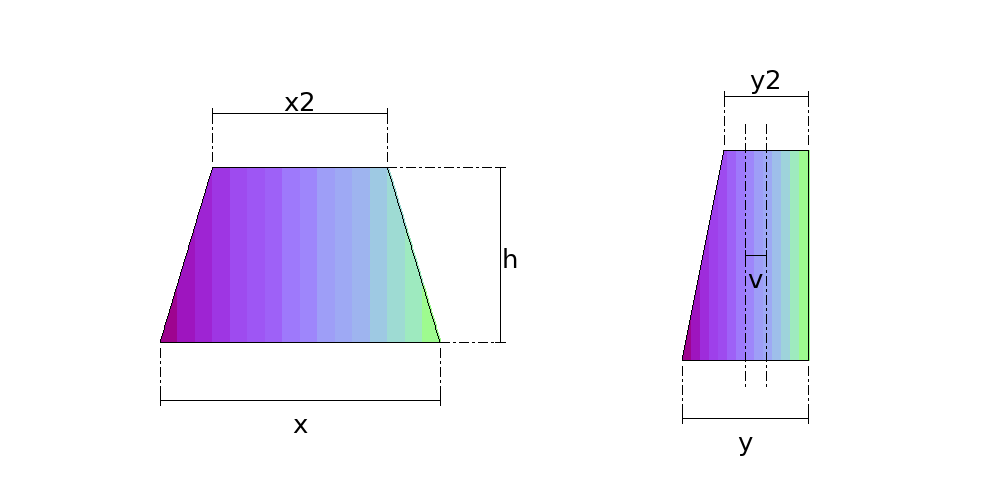
Measurements the calculation needs
- X Measurement X
- Y Measurement Y
- X2 Top X
- Y2 Top Y
- H Height
- V Outlet offset
- DV Divisions
- THK Thickness
Worked example
The values the form comes pre-filled with, run through the tool itself:
| Measurement X | 800 mm |
|---|---|
| Measurement Y | 300 mm |
| Top X | 500 mm |
| Top Y | 200 mm |
| Height | 500 mm |
| Outlet offset | 50 mm |
| Divisions | 16 |
| Thickness | 3 mm |
| The flat pattern fits a plate of | 1329 × 1191 mm |
Frequently asked questions
- Does it do both concentric and eccentric?
- Both, and everything between. With the outlet offset at zero it is the CONCENTRIC reducer. With the offset at half the difference between the two widths it is the ECCENTRIC one, flat on one side, where a straight run of each mouth lies in the same plane. Catalogues sell those as two items; here it is the same form with one number changed.
- Why does the flat side matter?
- Because flat-oval duct exists to run tight against something -- a ceiling, a slab, the underside of a beam. A concentric reducer drops the smaller size away from that face and you lose the headroom the oval went out to find. The eccentric one keeps the seated side where it was.
- Can the oval turn ninety degrees between the two mouths?
- No, and it is worth saying why. This part is exact because both mouths share the SAME layout and the features correspond one to one -- straight to straight, half-round to half-round. Turned ninety degrees, the straight runs below would meet the half-rounds above, and the correspondence that makes it exact would be gone. That is a different part, and a much heavier one.
- Do the straight runs come out flat?
- They do, and that is why this part carries no crease note. The two lines -- the lower and the upper -- are parallel to the same axis, and two parallel lines define a plane, so each run becomes a flat trapezoid. Both joins with the half-rounds are tangent, so the plate passes from one to the other without a break.
- Why can the mouths not be round?
- Because then it is not this part. With the length equal to the width the oval becomes a circle, the trapezoids degenerate and the part is a cone -- and there is a part for cones, and one for round-to-oval. The calculation asks for at least a millimetre of difference at each mouth, the same guard as both neighbours.
Calculate a Oval to Oval Reducer
An account is required. The free tier covers 20 calculations a month.