Cone flat pattern
What it is
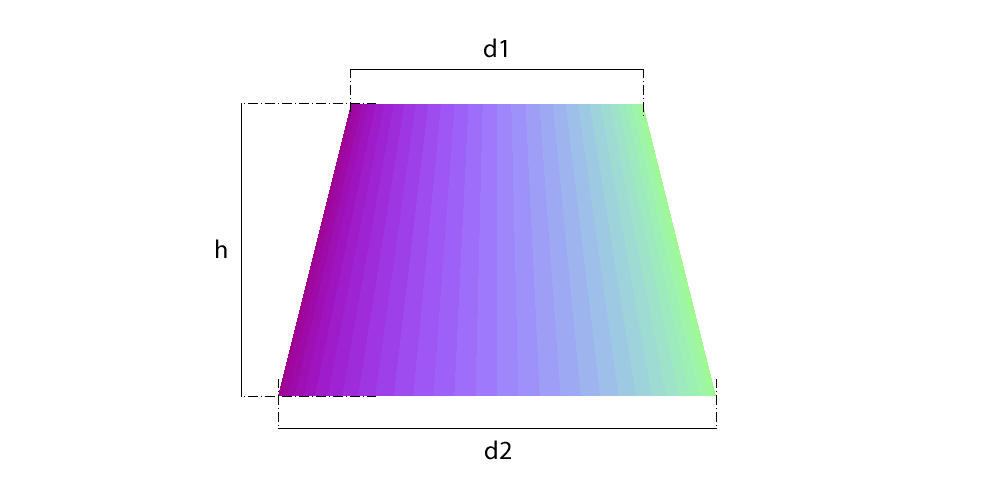
The truncated cone, or concentric reducer, is the transition between two diameters on the same axis. Developed, it becomes an annular sector: two concentric arcs closed by two straight sides. It is marked out with a trammel from the centre, using the outer and inner radii.
Where it is used
Pipe reducers, funnels, hoppers, stack transitions, silo and cyclone outlets.
Measurements the calculation needs
- D1 Diameter 1
- D2 Diameter 2
- H Height
- THK Thickness
Worked example
The values the form comes pre-filled with, run through the tool itself:
| Diameter 1 | 800 mm |
|---|---|
| Diameter 2 | 1200 mm |
| Height | 800 mm |
| Thickness | 3 mm |
| The flat pattern fits a plate of | 3407 × 1279 mm |
Frequently asked questions
- Which diameter goes in D1 and which in D2?
- D1 is always the smaller and D2 the larger — the calculation rejects the opposite. The height is the vertical distance between the two openings, not the slant length.
- How do I mark the sector out without CAD?
- With a trammel. The result gives both radii and the sector angle: fix the centre off the plate, scribe the two arcs and close with the straight sides. It is the traditional layout method, with the numbers checked.