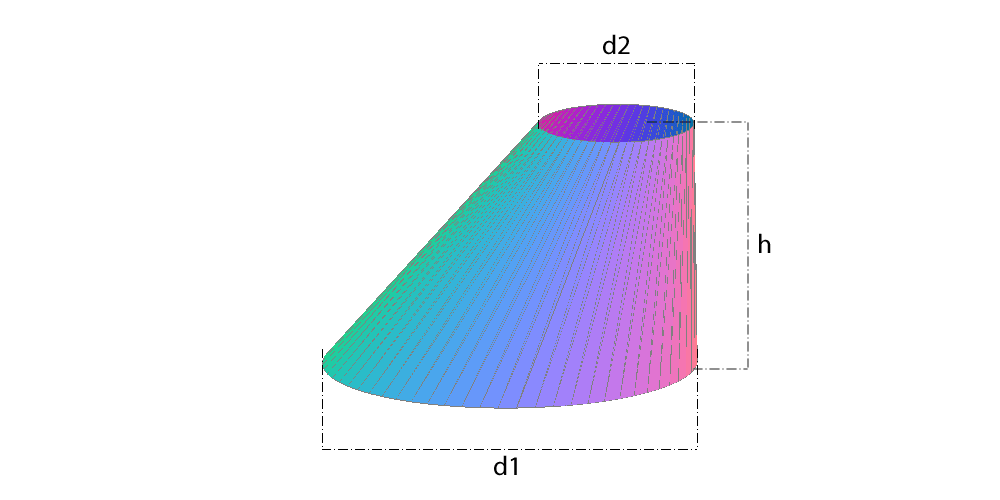
Oblique Cone flat pattern
What it is
In an oblique cone the two diameters do not share an axis: one opening is offset from the other. That breaks the symmetry, so the development is no longer an annular sector — it has to be solved by triangulation, dividing the surface into narrow strips and developing them one at a time.
Where it is used
Offset pipe transitions, exhaust manifolds, side nozzles on tanks, connections that must clear an obstruction.
Measurements the calculation needs
- D1 Diameter 1
- D2 Diameter 2
- H Height
- DV Divisions
- THK Thickness
Worked example
The values the form comes pre-filled with, run through the tool itself:
| Diameter 1 | 800 mm |
|---|---|
| Diameter 2 | 1200 mm |
| Height | 800 mm |
| Divisions | 16 |
| Thickness | 3 mm |
| The flat pattern fits a plate of | 2546 × 2356 mm |
Frequently asked questions
- Why does the number of divisions change the result?
- Because triangulation approximates the curve with straight segments. More divisions follow the outline more closely; fewer make the pattern easier to mark. For thin plate and large diameters, increase the divisions.
- Can this part be rolled?
- It is not a surface of revolution, so it does not come off in one pass. In practice it is formed in sections and checked against a template — which is exactly why the flat pattern has to be right before cutting.