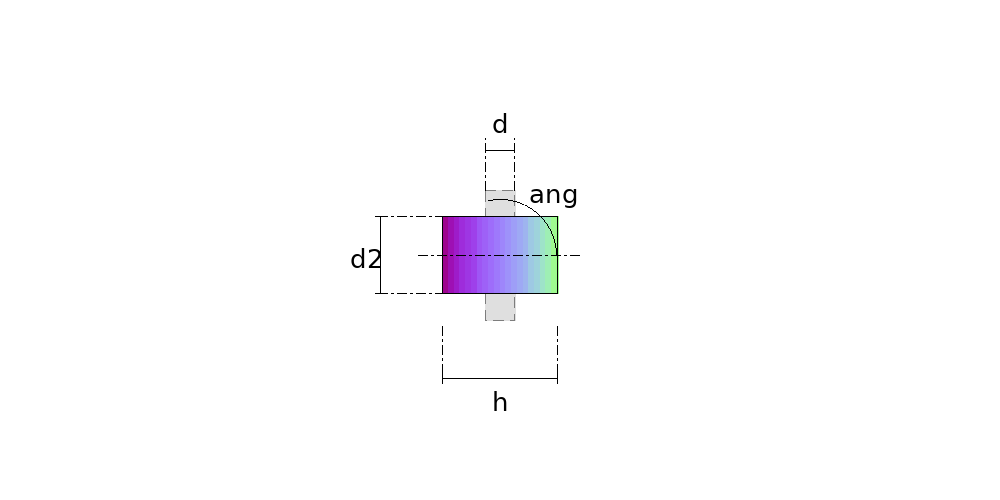
Cross Shell flat pattern
What it is
The run pipe of a cross, with both holes. A cross is made of three parts — this shell and the two branches, which are the pipe branch part in this catalogue. What this part gives, and the single-hole shell does not, is the RELATIVE POSITION of the two holes on the flat sheet: exactly what you cannot get by using the single-hole part twice.
Where it is used
Crosses in pipework, headers with opposed take-offs, distribution manifolds, twin runouts on air or steam lines.
Measurements the calculation needs
- D2 Diameter 2
- H Height
- D Diameter
- ANG Angle
- DV Divisions
- THK Thickness
Worked example
The values the form comes pre-filled with, run through the tool itself:
| Diameter 2 | 400 mm |
|---|---|
| Height | 600 mm |
| Diameter | 150 mm |
| Angle | 90° |
| Divisions | 32 |
| Thickness | 6 mm |
| The flat pattern fits a plate of | 1238 × 600 mm |
Frequently asked questions
- Where do the holes and the seam sit on the sheet?
- The holes at a quarter and three quarters of the stretch-out, and the seam ninety degrees from both — neither over a hole nor between them, but where the shell has plenty of solid metal.
- Can the two branches have different diameters?
- Not in this part: both holes come out alike. For branches of different sizes, calculate the single-hole shell twice and transfer the second marking — what you lose is the relative position arriving ready-made.
- Which diameter do I enter?
- The HOLE, as on the single-hole shell — for a branch set on top it goes at the branch's bore, for one set in, at its outside diameter.
- Why can't the hole be as large as the shell?
- Because each hole opens up to the width of the arc it occupies, and at equality that is half a turn. The two holes would touch and no shell would be left between them — the part stops existing before the arithmetic fails, which is why the guard is strict.