Cone with Conical Tap Hole flat pattern
What it is
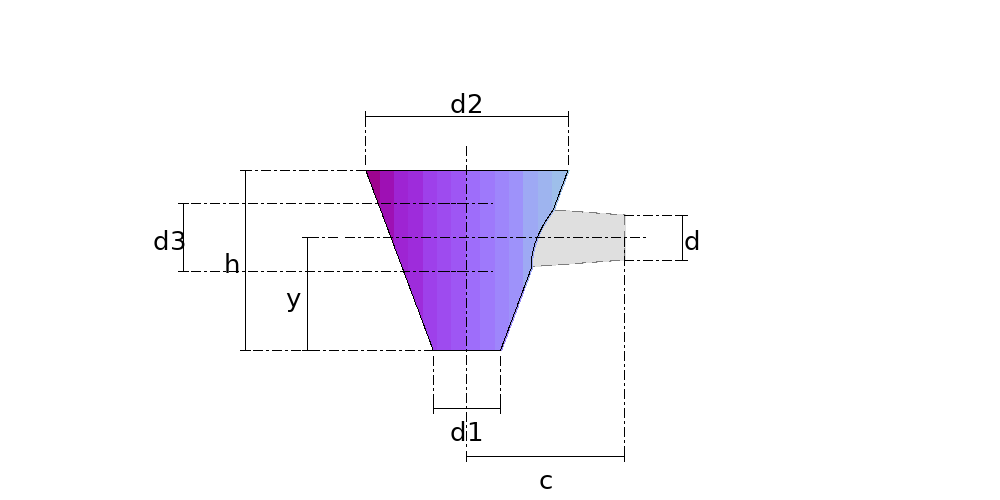
The pair of the conical tap on a cone: that part gives the template for the TAP, this one for the cone it enters. Enter the same tap in both and you have both templates for the job. With this pair the catalogue's branch matrix is complete on both rows — the branch and the hole — for all six branch-and-host combinations.
Where it is used
The hopper, silo or cyclone wall that receives a conical nozzle, marked out before rolling.
Measurements the calculation needs
- D1 Diameter 1
- D2 Diameter 2
- H Height
- D Diameter
- D3 Diameter 3
- Y Measurement Y
- C Branch length
- DV Divisions
- THK Thickness
Worked example
The values the form comes pre-filled with, run through the tool itself:
| Diameter 1 | 300 mm |
|---|---|
| Diameter 2 | 900 mm |
| Height | 800 mm |
| Diameter | 200 mm |
| Diameter 3 | 300 mm |
| Measurement Y | 500 mm |
| Branch length | 700 mm |
| Divisions | 32 |
| Thickness | 6 mm |
| The flat pattern fits a plate of | 2273 × 1084 mm |
Frequently asked questions
- Why will the cone with an ordinary branch hole not do?
- Because a conical tap reaches the wall already flared — that is what it is for — so the hole is larger and a different shape. The difference is stronger here than on a pipe, because both surfaces open out at once: the hole runs deeper at the top, where the cone is wide, and that is precisely where the tap is widest too.
- Do the hole and the tap mouth agree?
- They do, by construction. Both parts ask the same calculation, in the same place in the code, about where one surface meets the other. If they disagreed the hole would not fit the mouth — which is why the intersection is not written twice.
- Why mark the hole before rolling?
- Because marking a hole on a cone by hand is far worse than on a cylinder — the surface does not open into a rectangle, and there is no way to transfer the measurement without the sector. With the plate still flat the layout is direct.
- Can the hole be marked from the collar diameter?
- No. The collar is the free end, the smaller one; what crosses the wall is the section of the tap THERE, which is larger. Marking from the collar gives a hole that is too small, and the gap grows with the taper and with the length.
Calculate a Cone with Conical Tap Hole
An account is required. The free tier covers 20 calculations a month.