Inclined Square to Round flat pattern
What it is
The square-to-round transition with the circular opening tilted relative to the base and centred over it. It keeps the triangulated construction of the concentric transition: the part is symmetric about the plane through the axis and the line of steepest tilt, so the pattern develops half of it and mirrors that half.
Where it is used
Connections between equipment and pipework arriving at an angle, hoods with a tilted outlet, adaptations in existing installations where the duct cannot be plumbed.
Measurements the calculation needs
- H Height
- D Diameter
- X Measurement X
- ANG Angle
- DV Divisions
- THK Thickness
Worked example
The values the form comes pre-filled with, run through the tool itself:
| Height | 1000 mm |
|---|---|
| Diameter | 800 mm |
| Measurement X | 1400 mm |
| Angle | 30° |
| Divisions | 16 |
| Thickness | 3 mm |
| The flat pattern fits a plate of | 3550 × 2013 mm |
Frequently asked questions
- When do I need this instead of rectangle to round?
- When the round opening is not square to the base. If it is, the concentric transition is simpler and easier to form.
- Can the round opening sit off the centre of the base?
- Not in this part: it tilts about the centre of the base. An opening that is offset as well as tilted is a different part, with a different pattern, and is not in Planichapa yet.
- What is the angle measured against?
- The perpendicular to the base: the larger the angle, the more the round opening lies over. The angle has to be greater than zero -- at zero the opening is square and the part is the concentric transition, which exists on its own.
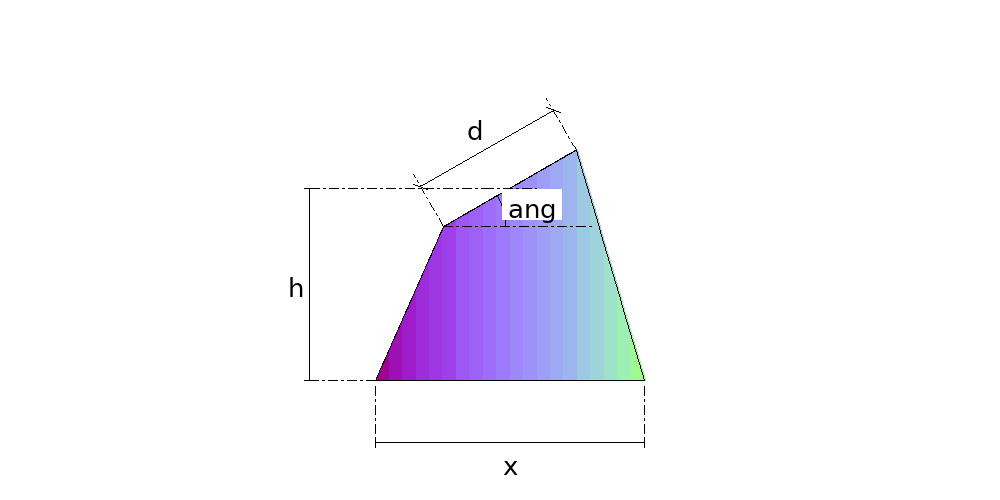
Calculate a Inclined Square to Round
An account is required. The free tier covers 20 calculations a month.